A fun and lightweight 10-minute (very basic, but highly-accessible) primer into the mechanisms by which new viruses appear to emerge via spillover infection and viral evolution. I was
pleased by the accuracy of the animations including efforts to show relative scale of microorganisms and the (correct) illustration of RNA as the genetic material of a coronavirus (many illustrators draw all viruses as carrying a double-stranded DNA payload).
From Real Monstrosities via Ed Yong via Matthew Cobb comes one of the best
cases of mimicry I’ve ever seen. Natural selection has been a fantastic artist here, giving a perfect illusion of three-dimensionality. In fact, this may be the most astonishing case
of mimicry I know.
It’s a moth from eastern Asia: Uropyia meticulodina—a fantastic dead-leaf mimic:
…
What I love about this thing is that it looks 3D. Even looking at photos or videos of the beast, your eyes will deceive you: its wings and back are flat, but look like
a dried-up and curled-up leaf. Incredible.
Why are testicles kept in a vulnerable dangling sac? It’s not why you think.
…
Some of you may be thinking that there is a simple answer: temperature. This arrangement evolved to keep them cool. I thought so, too, and assumed that a quick glimpse at the
scientific literature would reveal the biological reasons and I’d move on. But what I found was that the small band of scientists who have dedicated their professional time to
pondering the scrotum’s existence are starkly divided over this so-called cooling hypothesis.
I’ve just worked out what Jedward‘s debut single reminds me of. But first, because I expect –
hope? – that the folks who read this blog are oblivious to Irish teen popstars Jedward, I’ll fill you in. Identical twins John and Edward, Jedward lost at The X Factor in 2009 and then
went on the following year to release a single which reached #2 in the UK charts and #1 in the Irish. That single was Under Pressure (Ice Ice Baby), a simultaneous cover/mashup of Queen/Bowie’s fantastic Under Pressure, and
the monstrosity that was Vanilla Ice’s Ice Ice Baby.
It’s an obvious combination because it’s easy: perhaps the laziest music mashup I’ve ever heard. Ice Ice Baby already (very noticeably) sampled Under Pressure, although Van Winkle
denied this to begin with, so Jedward barely had to “shuffle the two together”. I’m not claiming that it’s not catchy, just that it’s not original.
Oh, and you’re likely to see more of them: they’re poised to be Ireland’s entry into the Eurovision Song Contest, this year.
Part Two – and the Aurochs
Aurochs(Bos primigenius) were a huge species of bovine – the predecessors of modern
domestic cattle – that roamed freely around much of Europe and Asia right up into the 17th century (although their numbers had diminished greatly since about the
12th-13th, primarily as a result of hunting, and the destruction of their habitat by climate changes and human expansion).
Painting of an aurochs. From ground to shoulder, these animals stood about two metres high, and weighed about a tonne. That's about the size and mass of a small rhinoceros, or -
perhaps more-aptly - eight to nine thousand quarter-pounders.
Why am I talking about these beasts, you ask. Well, apart from the fact that Jedward and the Aurochs would be an amazingly-cool band name, I’ve been reminded by the song above
of the Heck cattle. Allow me to explain:
Heck cattle are a breed of cattle which have been bred over the last 70 years or so as part of an effort to “breed back” the Aurochs by combining the relevant genetics of those species that succeeded them. The idea is that all of the
characteristics of the species can still exist in some form or another in modern domestic cattle, and with sufficient selective breeding it’s possible to get back whatever you want.
It’s controversial, especially when it’s used to “bring back” extinct species: after all, no member of the “new” aurochs will ever be genetically identical to any “old”
previously-living one. But then, no aurochs and it’s children will ever have shared the exact same genetic code, either. There’s a philosophical question, there: suppose we managed to
breed back an animal whose genes shared a specified level of similarity with a previously-existing species (say, 99.8% – about the level of DNA shared between all humans): could one
legitimately call it a member of that now-extinct species, recreated?
A male Heck cattle. Sure LOOKS like an aurochs, doesn't it?
Heck cattle aren’t even close, so this is just a thought experiment. They’re neither large enough nor distinct enough from domestic cattle to be called aurochs: they’re just a
primitive-looking breed of cattle. But there’s a point to this whole thing; hang in there.
Part Three – breeding back music
I wonder if it’s possible to “breed back” music by remixing and mashing-up, in a similar way to that seen by the breeders of the Heck cattle and other similar schemes. The family trees
are much smaller, but many of the same principles apply: Under Pressure (Ice Ice Baby) samples both Under Pressure and Ice Ice Baby. Ice Ice Baby, in turn, also samples Under Pressure.
There’s presumably original elements in the final song, too, which represents the introduction of new (genetic) material: let’s call that mutation. Add a few hundred more remixes and
mashups, samples and loops, and make a dozen more songs from these: would it be possible to “get back” the original Queen song by using samples of all of the surviving parts?
That depends, really. Do sufficient samples exist? There’s a lot of loss of information if everybody only uses the iconic dum-dum-dum-de-de-dumdum melody. Do we accurately know
what we’re trying to recreate? A big problem with the Heck cattle is that we know a lot about how they looked and only a little about their temperament, their behaviour, or – and let’s
face it, this is what people are actually asking – their taste. Is somebody’s memory of a song sufficient that they could be asked to identify a “recreated” piece of music, in the same
way as we try to use rare contemporary pictures of aurochs in an effort to reproduce them?
This is a rarely-seen Heck Mercury. It's a pale comparison to the real deal: it looks the same, but it doesn't sing even remotely as well. Sadly, efforts to find descendents of the
rock star himself have been hampered by his sexuality, a problem not encountered with the aurochs... although it would provide another, perhaps more-amusing, explanation for their
extinction.
Or maybe Jedward’s song reminded me of the Heck cattle simply because hearing it made me say, “Heck, no! What’s this bull?”
I read this Chick Tract comic, recently. I’d seen them before, but for some reason it was this week, and this particular article,
that riled me so much. I can honestly say I don’t think I’ve ever before been quite so agitated by something as harmless as a comic.
In the comic, an arrogant and obnoxious biology professor argues in front of a class with a Christian student on the topic of evolution. By a combination of bad science, straw man
arguments, a veiled ad hominem attack (the lecturer really is a model of intolerance) and the ultimate false dichotomy – that the only alternative to the theory of evolution involves
the implication that Christ must have died for our sins – the student persuades his teacher that his acceptance of evolution is incorrect.
It’s a weekend for pet hates, for me, and I suspect that the
thing that really got my goat with this comic was this particular panel:
In this panel, the student makes the premise that there are “six basic concepts of evolution”, and the professor agrees, listing them. But most of the concepts have nothing to do with
evolution at all!
(if anybody thinks it’s strange that the thing that annoyed me about this piece of propaganda wasn’t it’s conclusion but one of it’s premises, they could stand to know me a
little better – I have no objection to a belief in whatever you like, so long as it doesn’t tread on my toes… but I’m not keen on people mis-representing one another’s
positions)
The first four of the six basic concepts of evolution expressed in the comic are:
Cosmic Evolution – the Big Bang making hydrogen. The theory of evolution has nothing whatsoever to say about the appearance of the Universe and all of the time, space
and matter therein. The author seems to have confused the theory of evolution with, perhaps the big bang theory and and other cosmogenic theories.
Chemical Evolution – the appearance of higher [heavier] elements. Again, the theory of evolution has nothing to say about the fact that there’s more than just
hydrogen and helium in the Universe. On the other hand, nuclear fusion it’s
reasonably well-understood physics by now: we can do it in a lab, and we have strong, experimentally-backed theories about how it happens in stars and the like.
Evolution of stars and planets from gas – yet again, the theory of evolution has no statement to make on the formation of heavenly bodies (a term I use with no irony
whatsoever). This time the author’s gotten confused, probably, with the nebular hypothesis, the most popular contemporary explanation of the development of solar systems and galaxies. It must be
admitted: the hypothesis isn’t without it’s faults (to do with stuff like the conservation of angular momentum in accretion disks, and other stuff you don’t want to have to think
about without either a degree in space physics or, at least, a pint in front of you). But it’s still got nothing to do with evolution.
Organic Evolution – as it’s put so crudely in the comic, “life from rocks”. This still doesn’t have anything to do with the theory of evolution, which only
describes mechanisms by which organisms can change (with the potential to form new species as well as to produce adaptation within a species). This time around, the author seems to be
getting the theory of evolution mixed up with theories of abiogenesis, of which there several, and of which many are mutually-compatible (i.e. two of them could,
perhaps, both be factual).
Only the last two concepts – macro-evolution and micro-evolution (which are only generally described in separate terms for the benefit of those who
would argue that one is possible while the other is not: in scientific circles, it’s virtually unheard-of to discuss the two as if they were separate ideas, as they are in fact the same
idea based upon the same scientific understanding).
I could spend time picking apart the rest of the comic, but it wouldn’t achieve anything: all I really wanted to do is to point out that there are a number of very different and
unrelated theories that seem to be often misunderstood – sometimes by both sides – in debates on the subject of creationism, and in debates on the subject of atheism.
I’ve come across it a lot myself, as an atheist: people have told me that, as an atheist, I must believe in certain things, and then proceeded to attack those things, when these
premises may well be flawed (especially if they’re coupled with a misunderstanding of what those premises actually mean, as was the case in this comic).
Yes, I’m an atheist – which to me means that I have observed no compelling evidence for the existence of any deities (as defined by any non-naturalistic,
non-pantheistic explanation, on the subject of which I’m ignostic). I’m also
agnostic – which means that I believe that I do not know for certain, which I maintain is a perfectly rational position and is perfectly compatible with atheism. Don’t agree?
This
is the diagram I’m working from. While I find the concept of the existence of a deity ludicrous and implausible, it’s impossible to disprove, just like Russel’s teapot.
I also happen to accept the theory of evolution, because it’s a strong model with a lot of compelling evidence for it, and I haven’t yet seen a stronger one,
although I’m open to the possibility that one exists – Lamarkism, an alternative theory that could describe some of the evidence we’ve seen so far, is probably due a comeback.
I accept that abiogenesis has almost certainly occurred (that there was a point at which there was no life, and now – ta-da – there is!). I don’t know enough about
molecular biology to make a statement in any direction about which of the competing theories is the strongest; however, all of the scientific explanations I’ve heard have always
appeared to be stronger, to me, than any of the superstitious ones. I accept in principle the notion of a biogenetic start to life on Earth (life from elsewhere), but haven’t seen any
evidence for it that is not speculative.
Despite great strides in cosmogenesis in recreating theoretical early-Universe conditions that form functional and consistent models, I – like, I believe, every
other human – do not know “what happened before that?” (or even if such a question is valid at all). I’ve always had a personal fondness for the cyclic model, although I appreciate that it’s riddled with faults and, in fact, raises as
many questions as it resolves – I just like it for it’s almost-poetic completeness. I gather that it’s hard to accept modern understanding of the cyclic model without also accepting
loop quantum gravity, which I don’t
even understand, but as a model, it still makes me feel comfortable. Regardless: fundamentally, I don’t know “what happened first,” and I dispute that anybody else does,
either.
My point is, though, that all of these things can be taken independently, and I think it’s important that people understand and accept that. I’ve met evolutionist theists, biogenetic
anti-evolutionists, and even folks who believe that while a creator deity exists, created the universe, set life in motion, and then ceased to exist – they’re atheist abiogenetic
creationists. And that’s fine. I think they’re all wrong, and they probably think I am too, but that’s not a problem: we’ve a right to be wrong.
So next time somebody tells you what they believe about the existence or non-existence of a god or gods, their acceptance or not of the theory of evolution, their idea about the initial
appearance of life, of their belief in the quintessential beginnings of the universe, please don’t assume that you can guess the rest: there are some surprising folks out there with
whom you might have more in common than you think.
(and look, I managed to avoid mentioning my thoughts on ethics and morality and on determinism entirely!)
There’s a couple of computer games I’ve played recently that I thought I’d share with you so that you, too, can go play them and waste all your free time (hopefully you’ve got more free
time than I do to be wasted!).
RUCKINGENUR II
Free (as in beer) to download and play – download it here. Windows only
(requires the .NET framework), although there’s talk of a Linux port using Mono.
A self-confessed “game for engineers.” If you ever played Uplink and thought “Hmm, this is
good, but I’d rather be hacking hardware, not software,” then you really ought to give it a try. Ruckingenur II is a hardware hacking simulator: in it’s four missions you’ll be
determining the code of an electronic door lock, reprogramming a thumbprint scanner to accept your print, breaking the code of a (rather trivial) radio scrambling system, and defusing a
tamper-proof bomb. It’s all about interpreting the circuitry and analysing signals, rather than simply bridging circuits, as would be so much easier in so many of the missions.
Presumably your boss spent all of the money on the universal combined multi-meter/serial port analyser/debugger and didn’t have any budget left to get you a soldering iron and a
half-dozen lengths of wire. Ah well.
It’s only short. I got through all four missions in about 20 minutes, and I could probably have done it quicker if I hadn’t kept detonating the bomb at the end: the very first thing I
did was to examine the circuit (while the clock is ticking), correctly analyse which wire carried the signal to the expolosive, and send a quick pulse down that line, confirming my
suspicions by blowing my face off.
Give it a go and let me know how you get on, fellow geeks.
SPORE
The other game that’s consumed any of my time of late – by which I mean, of course, all of the free time I can find – is Maxis’s hot new title Spore.
In case you’ve been living in a cave for the last few years, Spore is the result of a collaboration between Will Wright (co-founder of Maxis, inventor of SimCity, The Sims, etc.) and Soren Johnson (right-hand man to Sid Meier during
the development of Civilization III and Civilization IV), it’s has been described as “the ultimate God game,” and as “SimEverything.”
During the game, you’ll help a species progress from being a tiny plankton-like creature living in a drop of water all the way up to being a galactic empire spanning many star systems.
The concept of “evolution” touted in the game isn’t really accurate, though, and what you’re actually doing – tweaking your species a little each generation towards your own goals,
rather than having the most successful genetic code reflected in the next generation – is closer to intelligent design than anything that any evolutionist would approve of.
Unfortunately, as its Zero Puncuation review gives away,
most of the fun of the game is shunted towards the Space Phase, the last of the five phases of the game (the others being Cell, Creature, Tribal, and Civilization), and it makes the
rest of the game seem a little short by comparison (note that I disagree with the statement in the Zero Puncuation review about carnivore-superiority: my first space-faring race had no
problem with befriending and converting other creatures, tribes and civilizations all the way). The Space stage, however, really shines.
Spore is an amazing achievement, and it’s continues to be fresh and surprising to play (thanks, in part, to the enormous scope of it’s in-game galaxy, but more thanks to the fact that
Spore “swaps” your creatures and other content with other players around the world), so I’d recommend you give it a go if you haven’t already. It’s a real shame that the DRM is so fucked-up,
because Maxis have just set themselves up for Spore to be the most-pirated game in history (after all, the pirated copy is now better than the
legitimate one). Nonetheless, it’s worth getting hold of a copy by one means or another just so you can see what the fuss is all about.
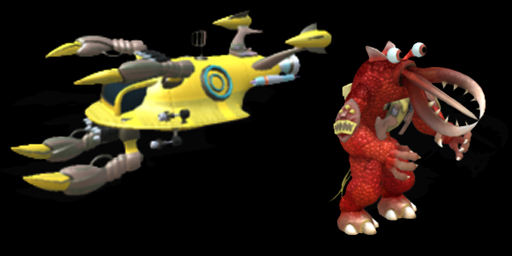
Oh, and here’s one of my species, a Gliblander, stood next to the species’ interstellar spacecraft, the Dirty Beast.
There’s an evolutionary process occuring in my wardrobe.
I have an approximately equal number of dark-coloured and light-coloured socks, but since we moved to The Cottage in the summer of 2006, I’ve been keeping my socks not in drawers but in a compartment in my unlit wardrobe. As a result, I
can only really see the light-coloured ones when getting dressed on a morning (and turning on the light would wake The
Morning Beast). I seem to get through clothes generally, and socks in particular, at quite a rate, and as a result I wear holes in and have to dispose of light-coloured socks far
more frequently than dark-coloured ones.
But when I buy new socks, they often come in mixed packs of light and dark colours. So the dark ones become more numerous, while the light population fluctuates. Okay, so it’s not
really like evolution, because the creation of new socks is not based on parentage, but there’s a real survival-of-the-fittest thing going on there, with those that are less-able to be
seen in the dark outliving their more-visible brethren, like those studies on peppered moths.
Getting dressed this morning, I couldn’t help but be reminded of Lovelock‘s
Daisyworld:
In the early 1980s, James Lovelock built a computer simulation known as Daisyworld which was designed to demonstrate the feasability of his Gaia hypothesis, a controversial theory
that suggests that planetary life, through it’s interaction with it’s environment, unconciously attempts to create an environmental equilibrium that is particularly suitable for the
continuation of life. The theory has been more recently undermined by hippy-types taking it on board as if it were some kind of neo-Pagan religion (contributed to, perhaps, by the
unfortunate choice of name).
In any case; I mention Daisyworld because of the great recreation of the simulation that I am most familiar with – the one that came packaged with SimEarth in 1990. Daisyworld is an Earth-like planet orbiting a star which is
slowly expanding into a red giant. The dominant life form on Daisyworld is a variety of flower which comes in a variety of lighter and darker shades (like socks – see; I can make a
point eventually). Early on in the star’s development, when the planet is cool, dark-coloured daisies are most common, and lighter-coloured ones are rarer. As the star expands and
throws more radiation at the planet, being able to reflect light becomes a desirable trait, and the genes for lighter-coloured petals lead to a greater survival rate, shaping the
evolution of the daisies. Early in the simulation, almost all daisies are dark, and towards the end – right before the star engulfs the planet and kills all of the daisies, anyway –
virtually all of the daisies are light.
Lovelock expands on this to demonstrate that the colour change also helps to keep the overall planetary atmospheric temperature down as evidence for his “living earth” theories, but
that’s not the bit that interests me. I’m pretty sure that my socks aren’t trying – even accidentally – to maintain “wardrobe homeostasis.”
In any case, I was probably a little too young when I first played SimEarth to really appreciate the simplistic beauty of the models it demonstrated. I understood evolution and
why it worked, sure, but it still only took so long before I decided to see what would happen if I introduced dinosaurs to Daisyworld or something. As it happens, they over-populate,
eat all the daisies, and then die out from lack of food. Stupid dinosaurs. But they did do a good job of demonstrating how a particularly successful species can really fuck over the
biodiversity of a planet: they always seemed to prefer to eat the lighter-coloured ones.
Maybe that’s where all my socks keep disappearing to.